

The IDD Framework
An Integrated Architecture for Constitutional Democratic Governance
On this page
- The Architecture
- The Fifteen Components
- 01 · Citizen Sovereignty
- 02 · Generational Constitutional Renewal
- 03 · Electoral Legitimacy
- 04 · Rights, Responsibilities & Human Dignity
- 05 · The Integrity State
- 06 · Police-of-Police
- 07 · Independent & Accountable Judiciary
- 08 · Education as a Constitutional Institution
- 09 · Cultural Truth & Civilizational Memory
- 10 · Property, Consent & Economic Dignity
- 11 · Transparent Public Administration
- 12 · Anti-Capture Institutional Design
- 13 · Constitutional Transition
- 14 · Constitutional Self-Correction
- 15 · From Nation to IDD Community
- How the Framework Fits Together
- The Constitutional Principle
- Explore the Framework
Integrated Dharmic Democracy is not built around a single institutional reform.
It is a constitutional architecture in which citizen sovereignty, electoral legitimacy, rights, responsibilities, institutional independence, public integrity, civilizational continuity, constitutional renewal, and intergenerational responsibility are designed to work together.
The underlying premise is simple:
A democratic system is only as strong as the relationships among its institutions.
Strengthening elections while leaving oversight weak does not solve democratic failure. Judicial independence without accountability can create another form of institutional insulation. Rights without enforceable protections become declarations. Anti-corruption laws without independent enforcement may become symbolic. Constitutional stability without a mechanism for generational renewal can eventually become constitutional rigidity.
IDD therefore treats democratic governance as an interconnected system.
The following elements form its principal architecture.
The Fifteen Components
Select a component to read its explanation below.
Citizen Sovereignty
The citizen is the constitutional principal.
Read02Generational Constitutional Renewal
A Constitution must be stable enough to provide continuity but adaptable enough to remain legitimate across generations.
Read03Electoral Legitimacy
Voting determines who receives temporary authority to administer public institutions.
Read04Rights, Responsibilities & Human Dignity
Fundamental rights protect the individual from excessive governmental power and from majoritarian abuse.
Read05The Integrity State
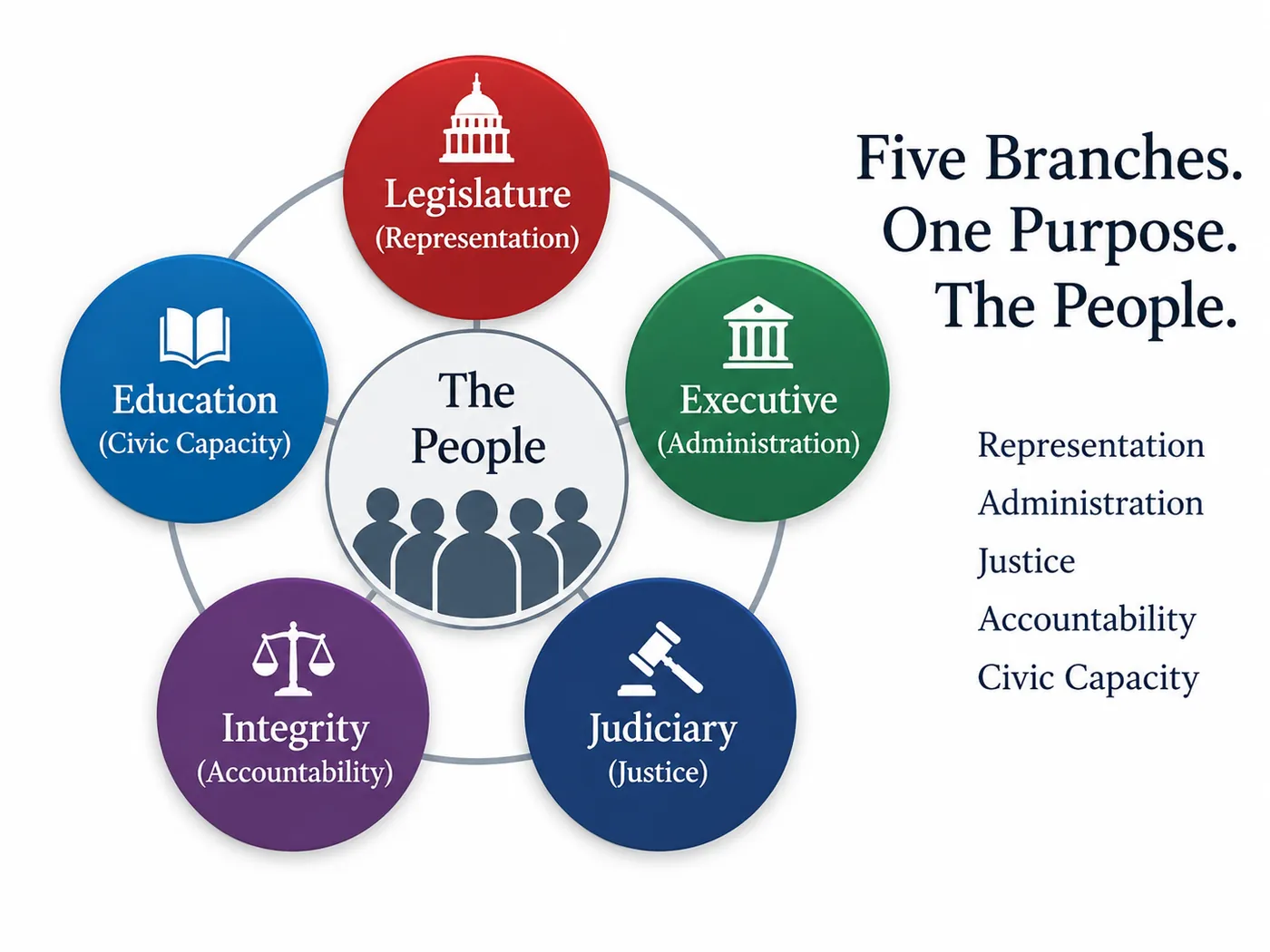
Traditional constitutional design frequently concentrates on three institutions: the legislature, executive, and judiciary.
Read06Police-of-Police
The police possess extraordinary authority.
Read07Independent & Accountable Judiciary
Judicial independence is essential to constitutional democracy.
Read08Education as a Constitutional Institution
Democracy depends upon citizens capable of understanding the institutions they are expected to govern through consent.
Read09Cultural Truth & Civilizational Memory
Every society inherits a history.
Read10Property, Consent & Economic Dignity
Property is not merely an economic asset.
Read11Transparent Public Administration
Democracy should be observable.
Read12Anti-Capture Institutional Design
Concentrated authority is efficient when exercised well—and dangerous when captured.
Read13Constitutional Transition
A new constitutional model cannot responsibly be imposed overnight.
Read14Constitutional Self-Correction
Many constitutional systems contain mechanisms for amendment.
Read15From Nation to IDD Community
IDD begins at the national constitutional level.
ReadCitizen Sovereignty
The citizen is the constitutional principal.
Government institutions exist because citizens establish them, authorize them, finance them, and entrust them with temporary powers.
IDD therefore rejects the idea that sovereignty becomes dormant between elections.
Elections are one expression of citizen sovereignty, but not its entirety.
Citizens must also have meaningful access to information, mechanisms of accountability, avenues for complaint and review, constitutional protections against institutional abuse, and an ultimate role in constitutional renewal.
Public officials do not own governmental authority.
They administer it temporarily on behalf of the citizenry.
The state serves the citizen; the citizen does not exist to serve the state.
Generational Constitutional Renewal
A Constitution must be stable enough to provide continuity but adaptable enough to remain legitimate across generations.
IDD therefore introduces a principle of periodic constitutional review.
At generational intervals, the constitutional system itself should be examined—not merely individual laws or isolated amendments.
Citizens should be able to ask:
Is the constitutional architecture still serving its intended purpose?
Have institutions accumulated powers never envisioned when they were created?
Have technological, social, economic, or geopolitical changes made parts of the system obsolete?
Are rights sufficiently protected?
Are accountability mechanisms still working?
Should particular provisions be retained, amended, redesigned, or replaced?
IDD proposes that constitutional renewal occur through an orderly democratic process rather than waiting for institutional collapse, revolution, or national crisis.
Constitutional renewal should be a feature of democracy, not evidence of its failure.

Electoral Legitimacy
Voting determines who receives temporary authority to administer public institutions.
IDD therefore gives special importance to the legitimacy of electoral outcomes.
The framework examines mechanisms intended to strengthen the connection between electoral victory and genuine public consent, including majority thresholds, runoff procedures where necessary, meaningful NOTA mechanisms, recall provisions, and safeguards against political systems in which officials can obtain substantial power with only limited support from the electorate.
The larger principle is that democratic legitimacy should reflect more than procedural victory.
Authority should rest upon demonstrable public consent.
IDD consequently treats electoral design as a constitutional question—not merely a matter of election administration.
Rights, Responsibilities, and Human Dignity
Fundamental rights protect the individual from excessive governmental power and from majoritarian abuse.
IDD strongly preserves that principle.
But the framework also recognizes that a democratic society cannot remain healthy if rights are permanently separated from responsibilities.
Freedom of expression exists alongside responsibility for truthful civic discourse.
Public authority exists alongside responsibility to the citizen.
Institutional independence exists alongside accountability.
Citizenship provides protection while also carrying obligations toward the constitutional community.
IDD therefore seeks a constitutional balance in which:
liberty is protected, responsibility is recognized, and human dignity remains fundamental.
Responsibilities are not instruments for eliminating rights.
They help sustain the social and institutional conditions under which rights can survive.
The Integrity State
Traditional constitutional design frequently concentrates on three institutions: the legislature, executive, and judiciary.
IDD argues that modern democratic systems also require a constitutionally protected integrity architecture.
Corruption, political capture, administrative collusion, conflicts of interest, and institutional self-protection can occur within any branch of government.
The central question therefore becomes:
Who watches the guardians?
IDD develops independent integrity mechanisms intended to operate outside ordinary political control.
These mechanisms may employ institutional separation, randomized procedures, distributed authority, protected reporting channels, public transparency, and structural safeguards against coordinated capture.
The objective is not to create another political center of power.
It is to make integrity itself a constitutional function.
Police-of-Police and Independent Public Oversight
The police possess extraordinary authority.
They may investigate, detain, search, use force, and initiate processes capable of profoundly affecting a person's liberty, reputation, livelihood, and life.
That power requires equally serious accountability.
IDD therefore develops the concept of Police-of-Police—POP: an independent oversight architecture capable of investigating misconduct, corruption, abuse of authority, deliberate non-enforcement, politically motivated action, and institutional protection of wrongdoing.
The principle extends beyond policing.
No institution exercising coercive governmental power should depend exclusively upon internal mechanisms to investigate itself.
Accountability must remain institutionally independent from the power being examined.
An Independent and Accountable Judiciary
Judicial independence is essential to constitutional democracy.
But independence should not mean institutional immunity from accountability.
IDD seeks to protect courts from political interference while simultaneously reducing opportunities for favoritism, corruption, permanent institutional capture, or concentrated appointment power.
The framework examines mechanisms such as diversified nomination, randomized procedures, transparent qualification standards, defined terms where appropriate, independent integrity review, and structural safeguards intended to protect both independence and accountability.
The objective is not a judiciary subordinate to elected government.
Nor is it a judiciary isolated from meaningful constitutional accountability.
It is an institution capable of administering justice independently while remaining responsible to the constitutional order.

Education as a Constitutional Institution
Democracy depends upon citizens capable of understanding the institutions they are expected to govern through consent.
IDD therefore gives education a constitutional importance that extends beyond ordinary public administration.
Civic knowledge, historical literacy, critical reasoning, scientific understanding, constitutional awareness, and the ability to distinguish evidence from manipulation are necessary for meaningful democratic participation.
Educational institutions should not become instruments of temporary political control.
Nor should the historical and civilizational inheritance of a society be erased because governments or intellectual fashions change.
IDD consequently explores stronger structural independence for education while preserving academic inquiry, intellectual competition, and openness to evidence.
An uninformed citizen may possess the right to vote while lacking the information necessary to exercise sovereignty effectively.
Cultural Truth, Roots, and Civilizational Memory
Every society inherits a history.
IDD recognizes a Right to Cultural Truth and History: the right of individuals to access, study, preserve, question, and understand the historical and civilizational inheritance from which their society emerged.
This includes family, local, regional, national, Indigenous, civilizational, and human history.
Such recognition does not establish superior citizenship based upon ancestry, ethnicity, religion, or cultural identity.
IDD instead joins two principles:
A civilization should not be compelled to forget itself.
No citizen should possess lesser constitutional standing because of origin or belief.
Historical study must remain open to evidence, correction, new discovery, and competing interpretations.
Civilizational memory and intellectual freedom should coexist.
Property, Consent, and Economic Dignity
Property is not merely an economic asset.
For many citizens it represents accumulated labor, family security, livelihood, independence, agricultural continuity, and intergenerational inheritance.
IDD therefore places strong emphasis upon property rights and meaningful owner consent.
The framework rejects the presumption that public objectives automatically justify uncompensated or coercive dispossession.
Government may identify public needs, develop alternatives, negotiate, purchase property voluntarily, and create incentives.
But the citizen should not become merely an obstacle to administrative convenience.
IDD therefore treats consent, transparency, fair dealing, and protection against coercion as essential components of property rights.
Economic development should strengthen citizens rather than require their involuntary sacrifice.
Transparent Public Administration
Democracy should be observable.
Citizens should be able to understand how public decisions are made, how public money is spent, how complaints are handled, how institutions respond, and who bears responsibility when governmental processes fail.
IDD therefore gives transparency an operational role rather than treating it as an abstract principle.
Digital public systems can make government increasingly auditable.
Citizen portals, complaint tracking, public expenditure records, institutional performance indicators, decision histories, and accessible governmental data can reduce the informational distance between citizens and public institutions.
Transparency alone cannot eliminate corruption.
But opacity makes corruption far easier.
Public authority should leave a public trail.
Institutional Decentralization and Anti-Capture Design
Concentrated authority is efficient when exercised well—and dangerous when captured.
IDD therefore emphasizes institutional designs that make coordinated capture more difficult.
No political party, bureaucracy, judicial network, financial interest, or administrative faction should easily be able to dominate every mechanism intended to constrain it.
Distributed powers, independent selection processes, randomized procedures, limited terms, transparent records, multiple review channels, and structurally separated oversight mechanisms can increase institutional resilience.
The objective is not endless fragmentation.
It is functional independence within a coherent constitutional system.
Constitutional Transition
A new constitutional model cannot responsibly be imposed overnight.
Institutions must be created.
Officials must be selected or transitioned.
Laws must be harmonized.
Courts require continuity.
Citizens require information.
Public agencies must continue functioning throughout the change.
IDD therefore includes a structured constitutional transition rather than treating adoption as a single-day event.
The proposed framework provides a 999-day transition period, accompanied by scheduled review points, allowing institutions to be established, tested, evaluated, corrected, and progressively transferred into the new constitutional architecture.
The transition is designed around a principle:
Change should be deliberate enough to preserve stability and decisive enough to prevent the old system from simply reproducing itself inside the new one.
Detailed transition mechanisms are maintained in the supporting constitutional instruments and digital supplements.
A Constitution Capable of Self-Correction
Many constitutional systems contain mechanisms for amendment.
IDD goes further by asking whether the system itself can detect and correct structural failure.
A self-correcting constitutional architecture requires several elements working together:
- citizen access to information;
- independent oversight;
- institutional review;
- mechanisms for removing or correcting failed officials;
- constitutional courts or review structures;
- protected rights;
- electoral accountability;
- periodic constitutional reassessment; and
the ultimate authority of citizens to renew the constitutional settlement.
No constitutional system can eliminate human failure.
The objective is to prevent failure from becoming permanent.
From the Nation to an IDD Community
IDD begins at the national constitutional level.
But nations increasingly face problems that cannot be managed entirely within national boundaries: security, environmental degradation, trade, technology, migration, supply-chain resilience, energy, food security, cyber threats, and transnational corruption.
The framework therefore considers the possibility of cooperation among nations that have independently adopted and demonstrated the principles of Integrated Dharmic Democracy.
Such cooperation could eventually include preferential economic relationships, shared security arrangements, environmental commitments, scientific and technological cooperation, resilience planning, and other common institutions.
Membership is not intended simply as a diplomatic affiliation.
It rests upon constitutional compatibility.
A nation first adopts and demonstrates IDD domestically; international membership follows constitutional performance.
Integrity before expansion.
Trust before access.
Performance before scale.

How the Framework Fits Together
The individual components of IDD should not be read in isolation.
Citizen sovereignty requires meaningful elections.
Meaningful elections require informed citizens.
Informed citizenship requires education and access to truthful information.
Rights require independent courts.
Independent courts require integrity safeguards.
Police power requires external oversight.
Public institutions require transparency.
Transparency requires citizens capable of acting upon information.
Property rights require restraints upon governmental power.
Institutional independence requires accountability.
And all of these structures eventually require reassessment by future generations.
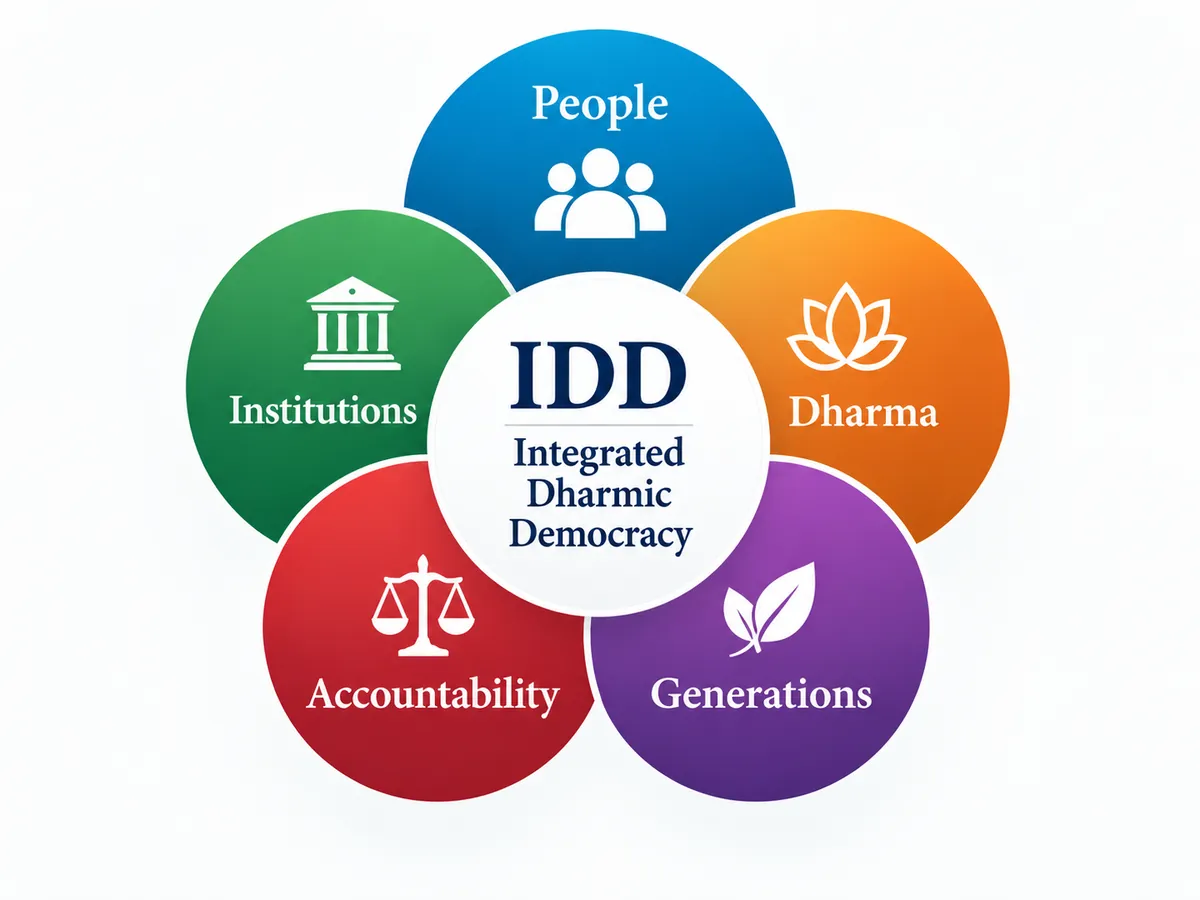
That interdependence is why the framework is called Integrated Dharmic Democracy.
The objective is not to perfect one branch of government.
It is to create a constitutional ecosystem in which institutions continually constrain, support, examine, and correct one another while remaining ultimately subordinate to the citizen.
The Constitutional Principle
IDD can be reduced to a sequence of relationships:
The citizen is sovereign.
The Constitution organizes delegated authority.
Institutions administer that authority.
Independent mechanisms protect integrity.
Rights protect the individual.
Responsibilities sustain the constitutional community.
Dharma places ethical restraint upon power.
Periodic renewal restores authority to each generation.
And the generation that receives the Constitution must leave the next generation free to examine it again.
That is the constitutional architecture of Integrated Dharmic Democracy.
Explore the Framework
The Book
Explore the chapters and organization of Integrated Dharmic Democracy.
ExploreDigital Supplements
Access the Model IDD Constitution, supporting constitutional instruments, transition materials, glossary, diagrams, and other downloadable resources.
ExploreFrom India, America, and Nepal to IDD
Explore the three constitutional studies from which the broader IDD framework emerged.
ExploreConstitutional Renewal
Examine the generational review and renewal principle in greater depth.
ExploreIntegrity and Public Oversight
Explore the Integrity State, Police-of-Police, citizen reporting, and institutional accountability mechanisms.
ExploreRights and Responsibilities
Review the constitutional relationship among liberty, citizenship, responsibility, property, history, and human dignity.
ExploreThe Book